Ink Under Pressure: What the Margins of Failed Firms Still Whisper
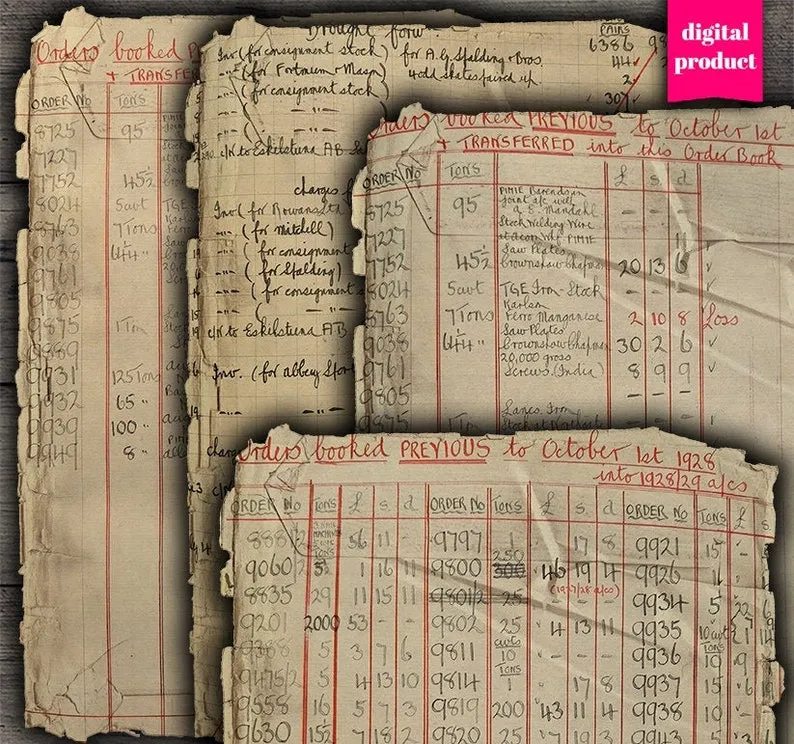
Photo: antique business ledger with handwritten notes and crossed-out entries, via i.etsystatic.com
In the manuscript collections of state historical societies across the country — the Minnesota Historical Society in St. Paul, the Baker Library at Harvard, countless county archives — sit the business records of firms that no longer exist. Hardware stores that closed in the 1970s. Regional banks absorbed in the mergers of the 1990s. Manufacturers whose names survive only on faded brick. Within these boxes, something unexpected waits: not the polished record of decisions, but the evidence of decisions being made.
A ledger entry crossed out and re-entered in different ink. A memo with a single word — "wait" — scrawled beside a projection. A question mark, pressed hard enough to dent three pages beneath it. This marginalia is the closest thing American business has to a fossil record of thinking, and it teaches more about judgment than most post-mortems ever will.
The Record the Delete Key Erased
Consider what the handwritten margin captures that modern tools do not. When a nineteenth-century merchant paused over an order of goods he could not quite afford, he might write the figure, strike it, and write a smaller one beside it. The hesitation survives. Both numbers exist. The reader a century later can see not only what was decided but how much it cost the decider to decide it.
Now consider the contemporary equivalent. A spreadsheet cell is overwritten. A draft email is revised until no trace of the first thought remains. A comment thread is resolved and archived. The decision arrives looking inevitable, as though it emerged fully formed. The struggle — which is where the actual learning lives — has been disposed of.
This is not nostalgia for penmanship. It is an observation about information loss. Digital tools record conclusions with perfect fidelity and deliberation with none. Paper, by contrast, records deliberation as a byproduct: the second thought sits right there, beside the first, in a different hand-pressure.
Hesitation as Data
Archivists who work with business collections notice patterns. Firms that survived long enough to leave rich paper trails often show a rhythm in their margins: questions before large entries, corrections clustered around expansions, doodles thickening during slow seasons. The handwriting functions as a kind of seismograph for organizational stress.
The failed firms tell a sharper story. In some of their records, the margins go quiet precisely when they should have been loudest — the years when the owner stopped annotating, stopped questioning, stopped striking through numbers that no longer made sense. Uncertainty unexpressed curdled into certainty unexamined. The absence of doubt in the record is often the most alarming thing in it.
There is a lesson here for any executive team. When deliberation disappears from your organization's artifacts — when decks arrive final, when models arrive clean, when the only version of the plan is the approved one — you are not seeing confidence. You may be seeing the margin go quiet.
A Practical Case for Returning Pen to Paper
None of this argues for abandoning digital systems; the ledger's searchability and the archive's permanence are genuine goods. But for decisions of consequence, there is a defensible discipline in drafting by hand first, and firms that adopt it tend to describe the same effects:
- Slowing produces seeing. Writing a projection longhand forces the writer to sit inside each number long enough to notice whether it is believed.
- Revision becomes visible. A struck-through figure preserves the first instinct, which is often the honest one. Teams reviewing these drafts can ask why the instinct was overridden.
- Commitment is calibrated. Ink is harder to unmake than pixels. That friction is a feature: it prices each assertion, and cheap assertions stop being made.
- The record serves successors. A future leader reading annotated plans inherits not just the strategy but the reasoning — including the doubts that proved prescient.
One practical adaptation used by some advisory practices: the "decision notebook," in which the lead on a major call drafts the recommendation longhand, annotates it over a week, and only then produces the digital version. The annotations become an appendix. Clients report that the appendix — the doubts, the discarded alternatives — is often the most consulted page in the final document.
What the Archive Asks of Us
The executives whose ledgers sit in regional archives were not more thoughtful than their modern counterparts. They simply used tools that refused to let thinking disappear. Every cross-out was a small confession; every margin note, a conversation with a future reader they would never meet.
That, finally, may be the strongest argument for ink under pressure. Handwriting assumes someone will look. It writes for the successor, the auditor, the historian — and in doing so, it writes more carefully for the present. The firms whose margins still whisper did not know they were leaving lessons. They were only thinking out loud. That, it turns out, was enough.