No Front Door, No Problem? Notes From Firms That Gave Up the Lobby
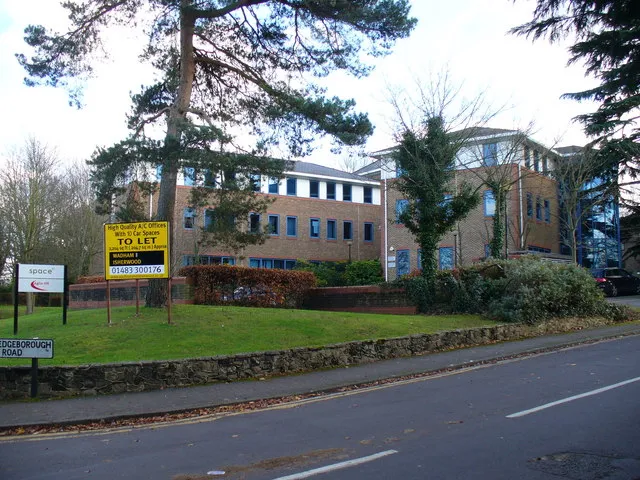
Photo: Colin Smith, CC BY-SA 2.0, via Wikimedia Commons
For most of the twentieth century, the office did something no one had to explain. It said, before a single word was spoken, that the firm was real. The brass letters on the glass door, the receptionist who knew your name, the conference room with the good view — these were not amenities. They were credentials rendered in drywall.
That arrangement is quietly dissolving. Across the United States, small professional firms — advisory practices, boutiques, two-partner shops — are watching their leases expire and choosing not to renew. Not downsizing to a smaller suite. Not moving to a coworking membership. Giving up the address altogether.
What follows is an attempt to take stock of the exchange: what a firm loses when it sheds its front door, and what it gains that the lobby never provided.
The Signaling Economy of Square Footage
It is worth being honest about why offices persisted as long as they did. Clients, particularly in professional services, read space as evidence. A firm that could afford twelve thousand square feet in a respectable building was, by that fact alone, presumed solvent and serious. The lobby was a collateral asset — pledged not to a bank but to every visitor's first impression.
This signaling function was never cheap. Commercial rent in mid-tier American cities routinely consumed ten to fifteen percent of a small firm's revenue, and the true cost was higher once furniture, parking, and the staff hours spent maintaining the space were counted. Firms paid this bill willingly because the alternative — appearing smaller than they were — felt commercially dangerous.
The pandemic broke the logic in both directions at once. Clients stopped visiting offices, so the impressions the space was purchased to make went largely unmade. Meanwhile, video calls flattened everyone into equally sized rectangles; a partner in a WeWork looked identical to a partner in a glass tower. The costume stopped being seen, and a remarkable number of firms noticed.
What Actually Disappears
Strip away the office and three things vanish, roughly in order of how much they are missed.
First, the rituals of proximity. The corridor conversation, the over-the-shoulder question, the shared lunch that doubles as quality control — these are real losses, and firms that pretend otherwise tend to discover it in the quality of their junior staff's work eighteen months later. Distributed firms that thrive tend to rebuild these rituals deliberately: scheduled working sessions rather than status meetings, documents that force asynchronous debate, occasional in-person gatherings that carry more weight precisely because they are rare.
Second, the archive of small evidence. An office accumulates proof — the wall of deal toys, the shelves of marked-up binders, the framed first dollar. Visitors read this material unconsciously, and it does persuasive work no website replicates. Firms without offices must manufacture this evidence in other forms: published writing, disciplined case studies, a body of work that speaks in the firm's own voice.
Third, the address itself. On letterhead, in an engagement letter, on a map. Some clients — particularly older ones, and those in industries where convention runs deep — still register the missing suite number as a small caution flag. This is not a reason to keep an office. It is a reason to be deliberate about everything else that signals substance.
What Replaces the Front Door
The firms that manage this transition well share a pattern. They do not simply delete the office; they redistribute its functions.
Credibility migrates to the work product. When a prospective client cannot walk your halls, the memo you send becomes your lobby. Firms that once leaned on their interiors must now let their thinking do the interior decorating — which, conveniently, favors firms that actually think well.
Hospitality migrates to the client. Meetings happen at the client's office, at a hotel near the airport, at a good restaurant. The burden of setting shifts, and many advisors report that client-site meetings produce franker conversations than conference-room meetings ever did. There is no power dynamic in whose turf you meet on when the turf is theirs and the intent is transparent.
Identity migrates to the operating agreement. An office papered over a thousand small inconsistencies — unclear hours, fuzzy responsibilities, improvised processes. Without it, those questions surface immediately. The firms that survive the transition are the ones that write things down: how work gets assigned, how quality gets checked, how a new hire learns the craft. The office was a culture of last resort; its absence demands a culture of explicit design.
A Question of Stakes, Not Squares
None of this argues that every firm should surrender its lease. For some practices — those built on local relationships, those in industries where presence is the product — the office remains a genuine asset, not a habit.
The deeper point is that the office was always a proxy. It stood in for competence, stability, and care because standing in was easier than demonstrating those things directly. The firms now operating without one are running a live experiment in whether the demonstration can stand on its own.
Early returns suggest it can — but only for firms willing to replace the costume with something more demanding: visible work, explicit culture, and a relationship with clients that no longer has anywhere to hide.